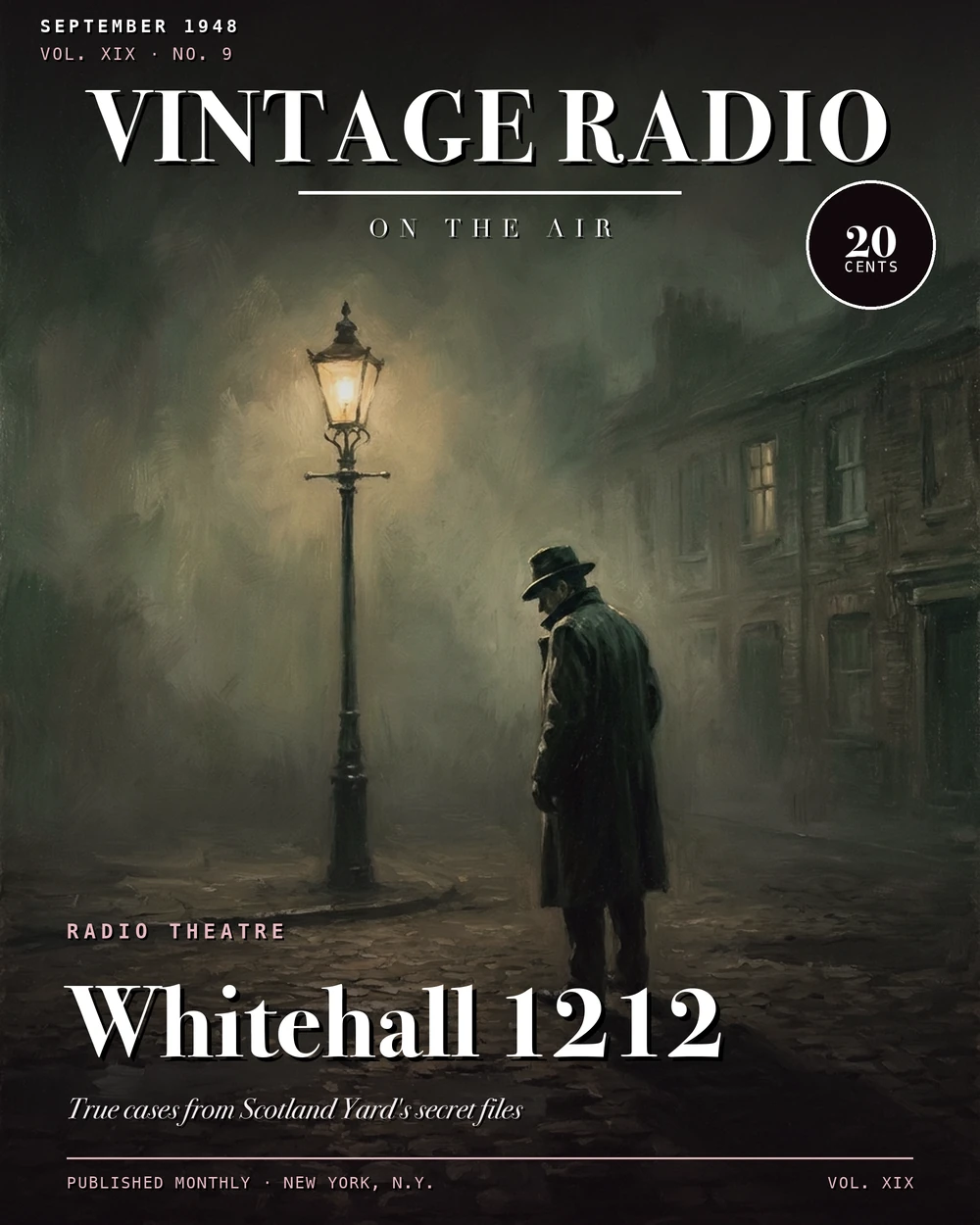
Whitehall 1212
How It Got on the Air
The premise of Whitehall 1212 was, by the standards of early 1950s radio, unusually well-credentialed. Each episode opened with a woman's alarmed voice ringing the title number on the telephone, answered by a calm "This is Scotland Yard." What followed wasn't invented crime drama but material drawn, with the Metropolitan Police's explicit cooperation, from actual Scotland Yard case files. The weekly introduction spelled it out: "For the first time in history Scotland Yard opens its secret files to bring you the authentic, true stories of some of its most baffling cases." Scripts were developed under special permission reportedly granted by Commissioner Sir Ronald Howe, and the research was prepared by Percy Hoskins, chief crime reporter of the London Daily Express. The show ran on NBC on Sundays — at 5:00 through the winter, then shifting to 5:30 — from November 18, 1951, to September 28, 1952.
Hoskins was not a casual hire. Born Percy Kellick Hoskins in Bridport, Dorset, in 1904, he had joined the Evening Standard at nineteen and spent more than five decades at the Daily Express, eventually becoming its chief crime reporter. He was known for exceptionally close relationships with senior police officers — close enough that MI5 opened a file on him in October 1938 and placed a telephone check on him by early 1941, suspecting he had detailed knowledge of live espionage cases. A peer once said Hoskins knew "where a great many skeletons were hidden in high places." He had already worked with producer Harry Alan Towers on an earlier Scotland Yard–themed program, Secrets of Scotland Yard, before signing on to research this one.
The structural device for each episode was an object from Scotland Yard's Black Museum — a collection that had grown out of the Prisoners Property Act of 1869 and acquired its name in 1877 when a reporter from The Observer, turned away from a visiting party, coined the term in print. Chief Superintendent John Davidson, introduced each week as the museum's caretaker, used each artifact to lead the listener into a case. A set of teacup fragments. A blood-stained pajama top. A blood-rusty knife. A bottle of The Glenlivet. These weren't narrative gimmicks so much as genuine catalogue items from one of the world's more unusual police archives.
The Man Behind the Microphone
Wyllis Cooper — born Willis Oswald Cooper on January 26, 1899, in Pekin, Illinois — was one of radio's genuine originals. He had served in World War I with the U.S. Cavalry on the Mexican border, achieving the rank of Sergeant, and later with the Signal Corps in France, where he was gassed at the Meuse-Argonne Offensive. He came to radio in Chicago in the mid-1930s, where he created Lights Out, a late-night horror anthology. Arch Oboler, who eventually succeeded him on that series, described Cooper in striking terms: "the pappy" of unique radio drama, an art form that originated "at midnight, in the middle thirties, on one of the upper NBC floors of Chicago's Merchandise Mart." Cooper had also written the 1939 screenplay for Son of Frankenstein, which introduced the much-parodied character of Ygor, and contributed to several Mr. Moto films. During World War II he served as a consultant to the Secretary of War and produced, directed, and wrote The Army Hour, a weekly news-and-variety program. By 1947 he had created Quiet, Please, which the American Schools and Colleges Association recognized that year as outstanding in the dramatic category, sharing honors with Theatre Guild of the Air.
Around 1940, when he moved to New York City, Cooper changed the spelling of his first name from "Willis" to "Wyllis" — reportedly to satisfy his wife's numerological beliefs. He died on June 22, 1955, in High Bridge, New Jersey.
On Whitehall 1212, Cooper served as both writer and director. He assembled an all-British cast specifically to give the show an authentic air — a decision that was very much his own. The cast included Horace Braham, Harvey Hayes (also billed as Harvey Hays in some sources) in the role of Chief Superintendent Davidson, Winston Ross, Lester Fletcher, Patricia Courtleigh, Pat O'Malley, and Guy Spaull. The show was produced in the United States at NBC despite every speaking voice in it being British.
What the Show Sounded Like
Whitehall 1212 took a documentary approach to crime drama. The focus was on investigative technique and forensic reasoning rather than sensational violence or scenes staged from the criminal's point of view. The stories were presented as "the plain unvarnished facts, just as they occurred," and the production style reinforced that claim — restrained sound design, controlled voice performances, no lurid reconstruction of crimes. Scotland Yard's perspective governed every episode; the listener followed the investigators, not the perpetrators. The names of real participants were changed in each episode, as the weekly introduction acknowledged, "for obvious reasons."
The actual cases varied in their textures. The first episode, "The Blitz Murder Case," centered on teacup fragments and concerned a woman and her companion killed with a shotgun. "The Case of the Late Mrs. Harvey" featured a blood-stained pajama top and a suit of men's clothing connected to a 1910 murder. "The Man Who Murdered His Wife" involved a body found covered in quicklime — though it turned out the woman had actually been killed by the Luftwaffe. "The Heathrow Affair" followed an unusually methodical criminal planning to steal a gold shipment from Heathrow airport. "The Case of the Winchester Bottles," one of the final episodes, concerned the murder of a four-year-old girl and Scotland Yard's decision to fingerprint an entire town to identify mysterious prints on a bottle. The final broadcast, "The Case of the Electric Torch," involved a drunkard killed by a man in love with his wife — with the torch used as the weapon.
Where It Fit — and Why It Struggled
Whitehall 1212 was the third radio program to mine Scotland Yard's Black Museum as its central device. Secrets of Scotland Yard, hosted by Clive Brook and produced by Harry Alan Towers, had come first in 1947. Running concurrently with Whitehall 1212 on Mutual — from January 1 to December 30, 1952 — was The Black Museum, hosted by Orson Welles and also produced by Towers. That program dramatized its cases in a more heavily theatrical fashion, including scenes reconstructed from the criminal's point of view, which made for a markedly different listening experience from Whitehall 1212's strictly police-side approach.
The overlap was a problem. Whitehall 1212 was considered too similar to the Welles program, and the comparison did it no favors. Cooper's constraint here was real: working from actual case files rather than invented material, he couldn't bring the creative latitude he had shown on Quiet, Please or the early Lights Out. The facts of a Scotland Yard file are what they are. The style could be polished, the casting could be authentic, the research could be impeccable — and all of those things were true — but the dramatic architecture was largely determined before Cooper sat down to write. The Black Museum with Orson Welles simply had more room to maneuver.
The series ran for 44 episodes, including an audition. Of those 44, 43 survive — only the second broadcast, "The Show Mission" from November 25, 1951, is missing. The surviving episodes run to roughly 21 hours and 23 minutes of audio. The series has appeared in commercial releases through Radio Spirits, with a program guide by Karl Schadow included in at least one CD edition, and a certified release was issued in April 2017.
Whitehall 1212 ended on September 28, 1952, after less than a year on the air. It was a competent, well-researched, authentically cast program that ran into the bad luck of sharing a device and a broadcast season with a more famous competitor doing a louder version of the same thing. Cooper had made it as credible as the premise allowed. That may have been the limit of the premise.